Fusion’s Shape of Net Power
The problem
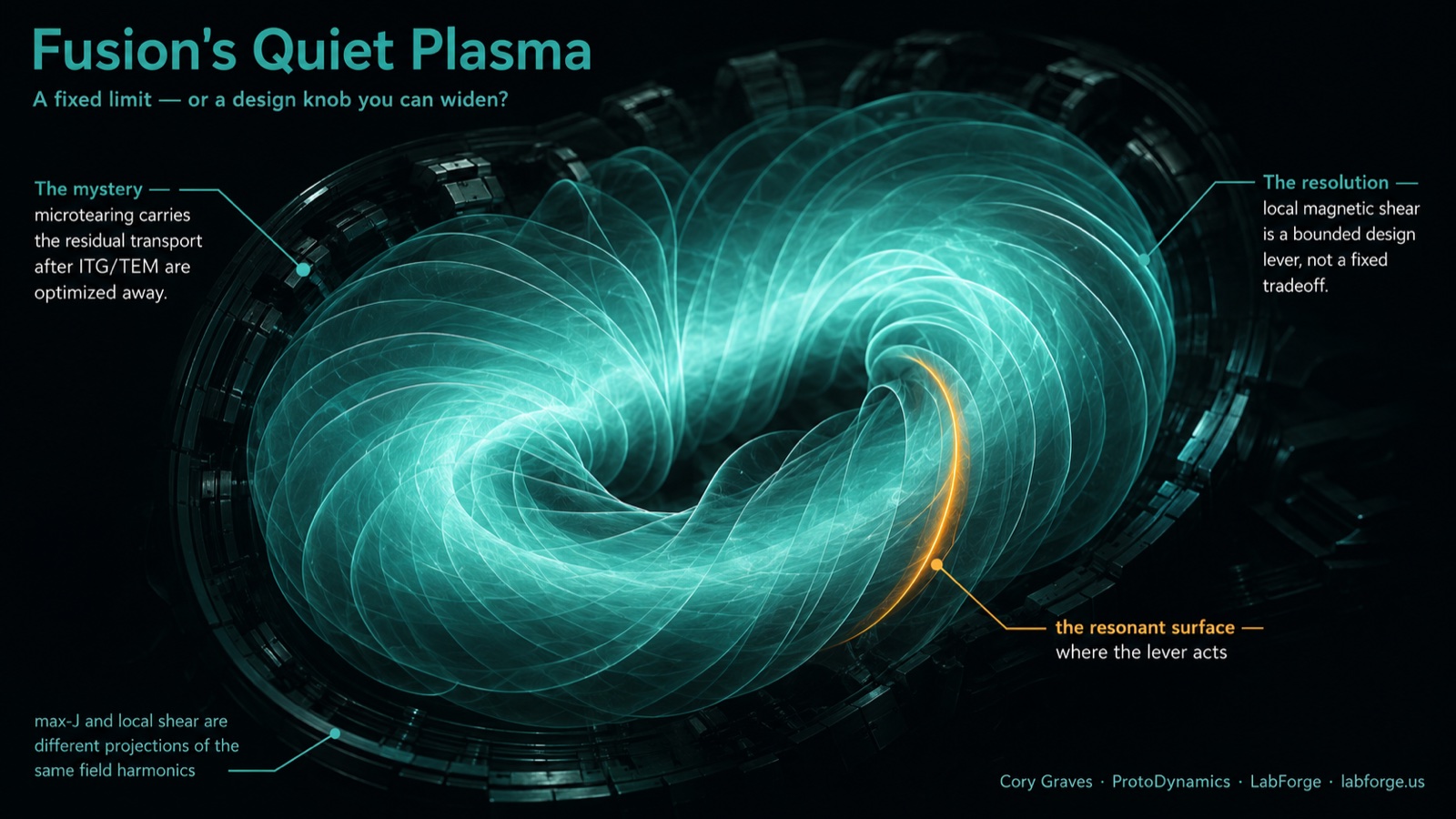
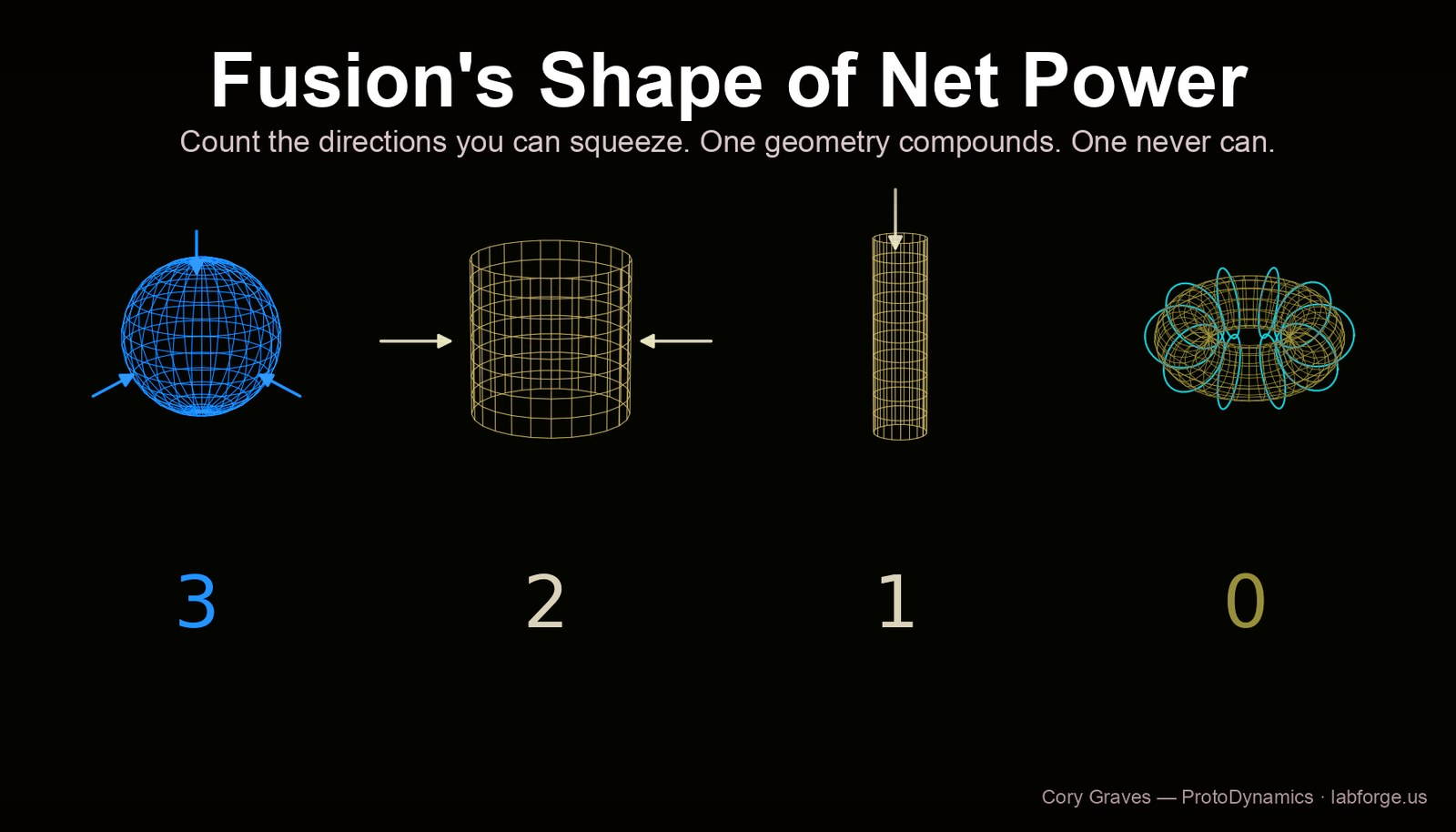
Seventy years of argument about reactor shape — tokamak against stellarator, big ring against small — and no winner. An argument that runs that long without resolving is usually arguing the wrong variable. Count something simpler instead: how many directions can you actually compress from? A sphere has three. A tube, two. A column, one. A torus has zero — one direction is a closed loop with nothing to push against, and the other is wrapped in the coils that make the field.
The falsifiable prediction
Compression buys density-time as Ck−1, where k is that count, and the same exponent governs how much energy a device can make. Total yield obeys one line: density squared, times reacting volume, times reacting time, must beat 1.59×1038 m−3s per 100 kJ of D-T at peak reactivity. Electrostatic confinement caps its own density by space charge, so the class cannot reach that product at any size. Confirm: no electrostatically confined device ever demonstrates net gain. Kill: one such device shows measured net gain with input energy honestly accounted.
Read the full write-up →